
THE BEST DAY TRIP TO MOUNT RAINIER FROM SEATTLE & WHAT YOU NEED

Mount Rainier National Park is the best day trip from Seattle, and this is your guide to making the most of that day
Written by Mark Dahl | updated July 25, 2026
Can you visit Mount Rainier as a day trip from Seattle? Yes, and it’s the trip I’d recommend first to anyone with a spare day in the city. Plan on roughly 2.5 to 3 hours of driving each way, 10 to 12 hours door to door, and picking one area of the park instead of trying to see all of it. Within that drive you go from downtown Seattle to an ancient forest standing beneath a glacier-capped volcano.
I’m a tour guide who has led hundreds of tours to Mount Rainier National Park, and in this article, I will provide you with everything you need to know to plan your perfect day trip.
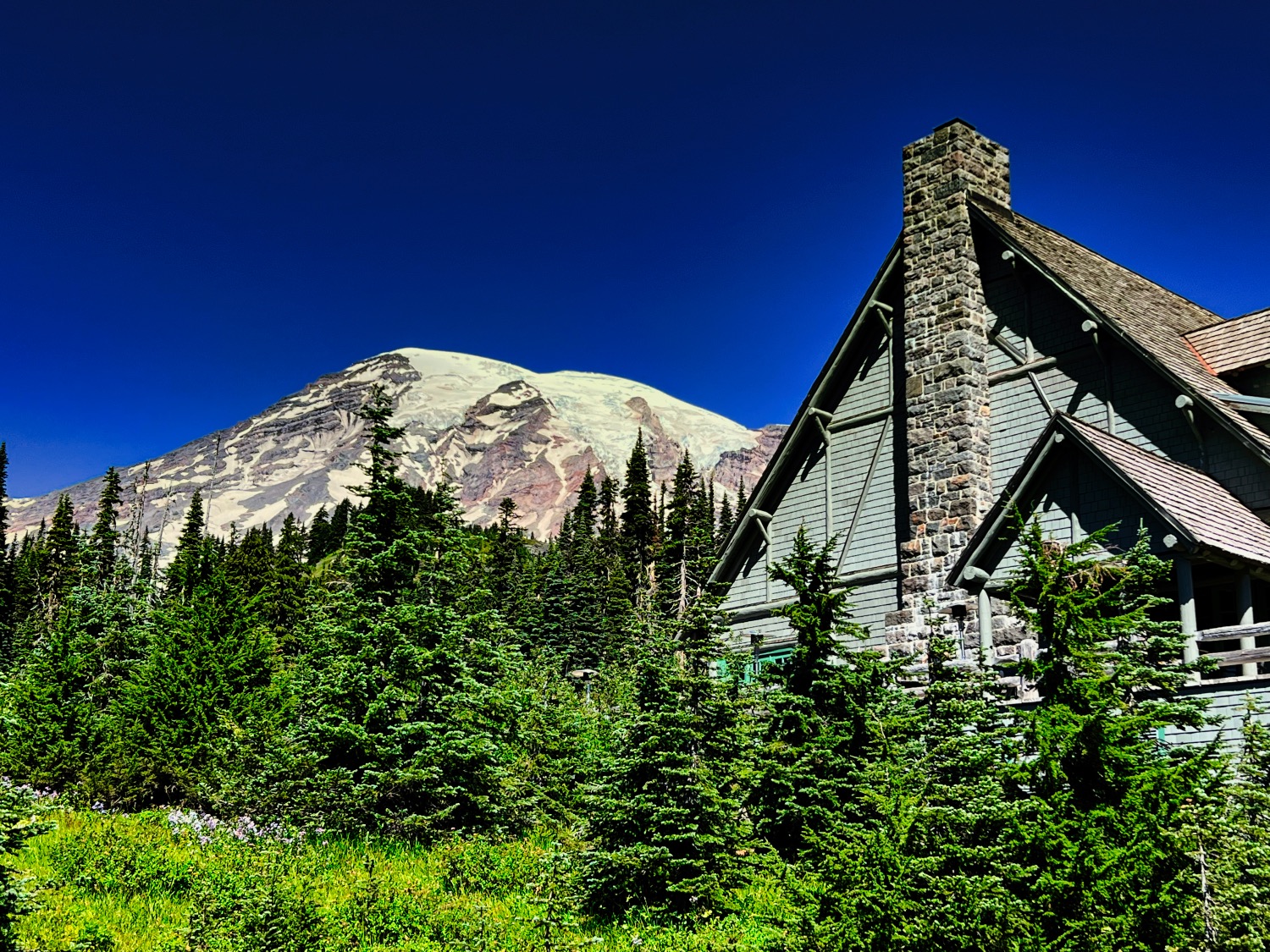
Paradise Inn with Mount Rainier
Step 1- Pick Which Area of the Park to Focus On
Pick one area and commit to it. Despite its proximity to Seattle, it isn’t feasible to see everything the park offers in a single day. The park covers 369 square miles and has 260 miles of maintained trails, so you’re going to have to make some choices.
Sometimes the weather and time of year make the choice for you– check out the NPS Website to see current road and trail closures, and read our seasonal travel guide to visiting Mount Rainer for a better idea of what to expect during different times of the year.
Paradise vs. Sunrise: which one should you choose?
Choose Paradise if it’s your first visit or you’re traveling outside of midsummer. Choose Sunrise if you’re visiting in late July or August and want big views with fewer people.
There’s a pretty good chance you’ll choose to focus on Paradise, especially on your first visit, since this is the most popular and most developed area of the park. At 5,400 feet, expect snow most of the year (roughly 640 inches annually, on average). Trails often aren’t accessible without snowshoes unless you’re visiting between midsummer and early fall, so outside those months check conditions ahead of time and consider lower-elevation trails.
For summer visitors, Sunrise is definitely worth considering. The higher elevation delivers spectacular views and generally smaller crowds, but the road usually doesn’t open until early July, so it isn’t an option most of the year.
Assuming the entire park is accessible, you’ll have to decide between seeing as much of the park as possible stopping for viewpoints and short hikes (this is the strategy that we use on our Mount Rainier tours), or focusing on one area where you can take some longer hikes.
Note: Closures shift from season to season, so confirm current status on the NPS current conditions page before you leave Seattle.

Reflection Lakes, Mount Rainier National Park
Step 2 – Plan How to Get There
You really have two options: driving yourself, or joining an organized tour like ours.There is no public transit to Mount Rainier National Park, and no train, bus, or shuttle service from Seattle to the park.
How long is the drive from Seattle to Mount Rainier?
Plan on 2.5 to 3 hours each way, depending on which entrance you’re headed for and how bad traffic is.
- To the Nisqually Entrance and Paradise (southwest corner): I-5 south, then SR 7 and SR 706 through Elbe and Ashford. This is the year-round route and the one most first-time visitors take. Figure about 2 to 2.5 hours to the entrance, plus another 30 to 45 minutes up to Paradise.
- To the White River Entrance and Sunrise (northeast corner): SR 410 through Enumclaw. Similar drive time, but only usable in midsummer and early fall when the road is open.
Add buffer on summer weekends. Both the drive and the entrance line can run long.
Should you drive yourself or take a guided tour?
Drive yourself if your main goal is a long hike or a specific trail, since tours are designed to accommodate the widest range of people possible. Take a guided tour if you’d rather not deal with the drive, the mountain roads, the parking, or the planning, and you want a guide who knows what’s open, what’s worth stopping for, and how to avoid the worst of the crowds.
Do you need a reservation to enter Mount Rainier?
No. Mount Rainier is not using a timed-entry reservation system in 2026, so no advance permit is needed to get through the gate. That’s a change from 2024 and 2025. The park is managing peak-season demand through parking management instead, which means the popular lots at Paradise and Sunrise can still fill early on summer weekends. Arriving early is more important now, not less.
One final option, for those in far better shape than me, is to ride your bike. I see cyclists on the steep roads of the park all the time and feel vicarious exhaustion just watching them. Not for the faint of heart, but worth mentioning.

Bridge over the Ohanapecosh River, Mount Rainier National Park
Step 3 – Create an Itinerary
I know, an itinerary sounds like it would ruin your fun, spontaneous day in the mountains. But if you don’t want to spend the day sitting in traffic, or realize you’re miles from the trailhead as night falls, planning is well worth whatever spontaneity gets lost.
How to beat the crowds and the entrance line
Summer is genuinely busy. According to the National Park Service, roughly 70 percent of the park’s visits happen between July and September, which concentrates well over a million people into a short season. Four things help:
- Start very early. Our Mt. Rainier tours aim to leave Seattle by 7 a.m., and that’s not an accident.
- Avoid weekends if your schedule allows. A Tuesday in August is a different park than a Saturday in August.
- Check the line before you commit. The park’s X account often posts when the entrance backup is bad, and Google Maps works too. As a rough rule, each mile of red at the gate equals about an hour of waiting.
- Consider a different entrance. When the roads are all open in summer, you can enter through the Stevens Canyon gate, which is usually far less busy, and leave through Nisqually, waving smugly at the miles-long line of cars waiting to get in.
A realistic one-day Mount Rainier itinerary
If you’re driving yourself and focusing on the Paradise corridor, a day that actually works looks something like this:
- 7:00 a.m. Leave Seattle
- 9:30 a.m. Arrive at the Nisqually Entrance
- 10:00 a.m. Stop at Longmire and stretch your legs on a short forest walk
- 10:45 a.m. Christine Falls and Narada Falls viewpoints
- 11:30 a.m. Paradise: visitor center, picnic lunch, and a meadow hike such as the Skyline Trail
- 2:30 p.m. Reflection Lakes for the classic mountain-and-water photo
- 3:30 p.m. Start back toward Seattle
- 6:30 p.m. Home for dinner
Shift everything an hour earlier on a summer weekend.
Picking your hikes ahead of time
If you want to do anything more ambitious than a mile, choose your trails before you go using AllTrails or the Washington Trails Association. Both have crowd-sourced trip reports on current conditions plus trail length, difficulty, and estimated time. Snow lingers on high trails well into July in a heavy year, and a trail that looks easy on paper can still be under several feet of it.
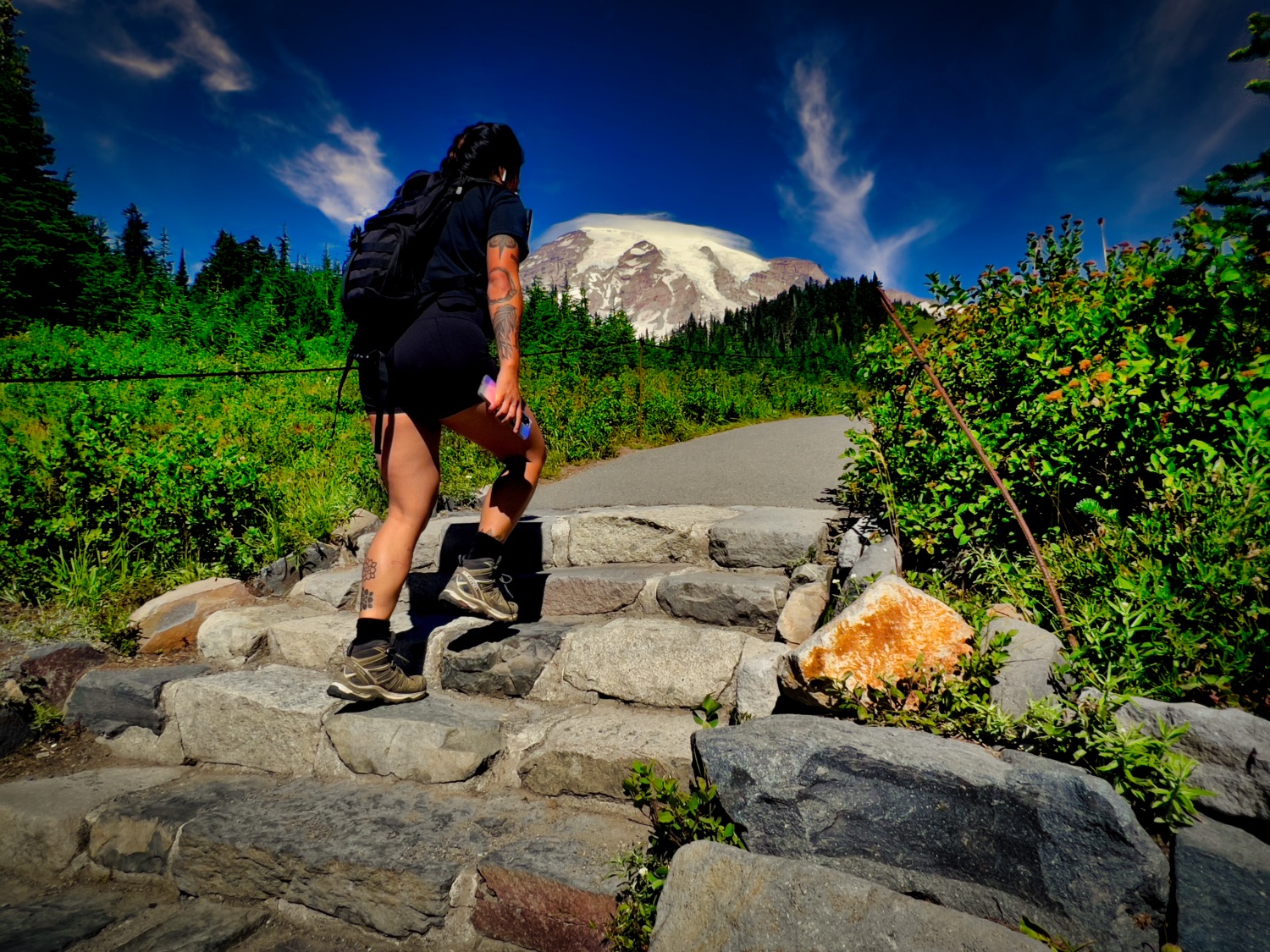
Hiking the Skyline Trail, Paradise, Mount Rainier National Park
Step 4 – What to Pack for a Mount Rainier Day Trip
What should I pack for a Mount Rainier day trip from Seattle?
Pack layers, waterproof hiking boots or your most comfortable shoes with good traction, sunblock, water, and your own food. Here’s the short list:
- Layers. Mountain weather changes fast, and Paradise can be 20 degrees cooler than Seattle.
- Waterproof hiking boots. Ideal during the rainy and snowy season, which is pretty much any time other than July and August. No boots? Wear the most comfortable shoes you own, preferably with good tread.
- Rain shell. This is the Pacific Northwest.
- Sunblock and sunglasses. The mountain can be surprisingly sunny, and snow reflects UV, which makes sunburn all the likelier.
- Food and water. There are a few places to buy provisions inside the park, but the options are extremely limited and overpriced. Pack a picnic. Trust me on this one.
- A full tank of gas. There are no gas stations inside the park. Fill up in Enumclaw, Elbe, or Ashford.
- Downloaded maps. Cell service inside the park ranges from spotty to nonexistent, so don’t count on navigation or trail apps loading once you’re past the gate.
Step 5 – Enjoy Your Mount Rainier Day Trip
This is when all of your planning pays off. Mount Rainier is one of the most spectacular sights in the world, and even if you’ve become habituated to seeing it from Seattle, the up close and personal view from within the national park is still breathtaking.
What if the mountain is hidden in clouds?
It happens, and it happens often. Given the rainy climate the Pacific Northwest is known for, there are plenty of days you can be on the mountain without being able to see the mountain. Check the NPS webcams before you leave to see what the view looks like. If it’s socked in, the day is still worth it: old-growth forest, rivers, and waterfalls are arguably better in soft gray light, and the lower-elevation areas around Longmire and the Ohanapecosh side stay beautiful in any weather.
If you would rather not have to do your own planning or driving, we would love for you to join one of our Mount Rainier Tours from Seattle, which include park admission and depart from several meeting points in downtown Seattle and SeaTac.
Prefer a Private Experience? Try Our 10-Hour Private Tour
If you want the freedom to customize your experience while still enjoying the convenience of a guided tour, check out our Private Mount Rainier Tour.
- Duration: 10 hours, year-round availability
- Private vehicle: Ride in a comfortable Chevrolet Suburban LTZ
- Hiking optional – enjoy as much or as little activity as you like
- Snowshoes available for free in winter
Customize your itinerary with your guide: visit Paradise or Sunrise Visitor Centers (depending on road conditions), stop at Christine Falls, Lake Tipsoo, or Reflection Lake, and enjoy a scenic drive through mountain towns like Elbe and Ashford.
This tour offers a relaxed, flexible way to experience Mount Rainier with hotel pickup, a private guide, and beautiful views every step of the way. It’s a good fit for families, photographers, or anyone looking for a more intimate experience.
However you choose to get there or how many times you’ve been, there’s always more to discover and Mount Rainier has a way of making every visit feel like the first time.
Frequently Asked Questions
- How long does it take to drive from Seattle to Mount Rainier National Park?
- The drive from Seattle to Paradise, the most popular destination in the park, takes approximately 2.5 to 3 hours each way without traffic. Weekend traffic and seasonal road work can add significantly to that, especially in July and August, which is why an early departure makes or breaks a day trip.
- Do I need a timed entry reservation to visit Mount Rainier National Park?
- No. Mount Rainier is not using timed-entry reservations for any part of the park in 2026, so no advance permit is needed. The NPS continues to monitor congestion and may revisit the policy in future years, so check the official NPS website before your visit.
- What is the best time of year to visit Mount Rainier on a day trip?
- Late July through September is the sweet spot, when wildflowers peak, snow has melted off most trails, and the Sunrise road is open. June and early October are quieter and still beautiful, though high trails may be snow-covered. Winter turns the park into a snowshoeing destination with only the Nisqually to Paradise corridor accessible. Our seasonal guide breaks it down month by month.
- How much does it cost to enter Mount Rainier National Park?
- Entrance is $30 per private vehicle for 7 days, $25 per motorcycle, or $15 per person on foot or bicycle. A Mount Rainier annual pass is $55, and the America the Beautiful Annual Pass is $80 and covers every federal fee site, which is the better deal if you’re visiting more than one park this year. The park is cashless, so bring a card. Our tours include park admission, so there’s nothing to worry about if you’re with us.
- Is a Mount Rainier day trip good for kids and families?
- Yes, with realistic expectations. The drive is long for young children, so break it up with short stops at waterfalls and viewpoints rather than committing to one big hike. Paved and easy trails near Paradise and Longmire work well for most families, and the visitor center at Paradise gives everyone a warm place to regroup. Our public tours are open to ages 5 and up, and our private tours have no age minimum.
- How much of Mount Rainier can you actually see in one day?
- Realistically, one corridor. Most day-trippers cover the Nisqually Entrance to Paradise route with stops at Longmire, Christine Falls, Narada Falls, and Reflection Lakes, which is a full and satisfying day. Trying to add Sunrise or the southeast corner in the same day means spending most of it in the car.